How We Plan and Install Your Floor
- Measure and inspect: We verify square footage, check door clearances, and note floor flatness and transitions to nearby rooms.
- Moisture and subfloor testing: We test concrete or wood substrates and recommend underlayments or vapor control as needed.
- Subfloor prep: High spots are shaved, low areas are patched, and fasteners are tightened so the new surface feels solid.
- Acclimation: Materials rest in the space to match room temperature and humidity for a stable fit.
- Layout planning: We balance plank widths, avoid slivers at walls, and align key sightlines through hallways and open rooms.
- Cutting and fitting: Clean, accurate cuts around jambs, vents, and stair nosings keep the floor looking intentional.
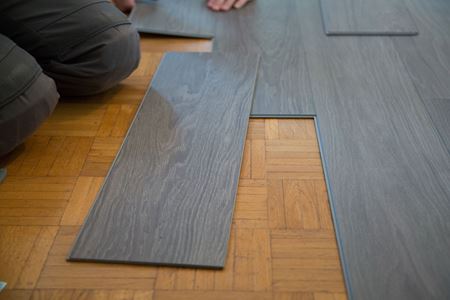
- Installation: Click-lock, loose-lay, or glue-down methods are chosen based on the room, traffic, and manufacturer guidance.
- Transitions and trim: We install reducers, thresholds, and base or shoe molding for a crisp, finished look.
- Clean-up and walkthrough: We tidy the area, review care tips, and confirm the result meets your expectations.
Care is simple: place walk-off mats at entries, add felt pads to furniture, avoid steam mops, and use pH-neutral cleaners. With these habits, a quality LVT floor keeps its finish and stays quiet underfoot for years.
LVT Flooring Installation Done Right
Every space is different, so we tailor LVT flooring to the way you live. Kitchens and baths often benefit from glue-down for rock-solid stability, while living rooms and basements may be perfect for click-lock with a sound-reducing pad. We'll explain what fits your home, your schedule, and your long-term plans so you're confident before we start.
Have radiant heat? We follow the manufacturer's heat-up schedule and expansion guidelines to protect the floor. Need continuity across rooms? We plan plank direction and transition placement so the eye flows and the floor feels like one design, not a patchwork.
Surfaces, Layouts, and Conditions We Handle
From tidy condos to busy family homes, we match materials and methods to the conditions on site. On wood subfloors, we secure panels, level dips, and address squeaks before a single plank goes down. On slabs, we test moisture and select the right underlayment or adhesive to control vapor so your LVT flooring stays flat and quiet.
We also plan for real-life details: long runs through open floor plans, door saddle height, flush vents, and clean transitions to carpet or tile. Stairs and landings get special attention with color-matched nosings so the look stays consistent and safe.
- Occupied homes where clean work zones and daily access matter
- Basements and lower levels that need moisture-aware assemblies
- Kitchens, baths, and laundry rooms that demand water resistance
- Sun-exposed rooms where expansion control is critical
- Commercial entries and offices that see steady foot traffic
In our experience, LVT flooring performs beautifully across the Greater Everett Area when the subfloor is tested, flatness is corrected, and the installation method matches the space. Those three decisions are where the long-term performance is won.